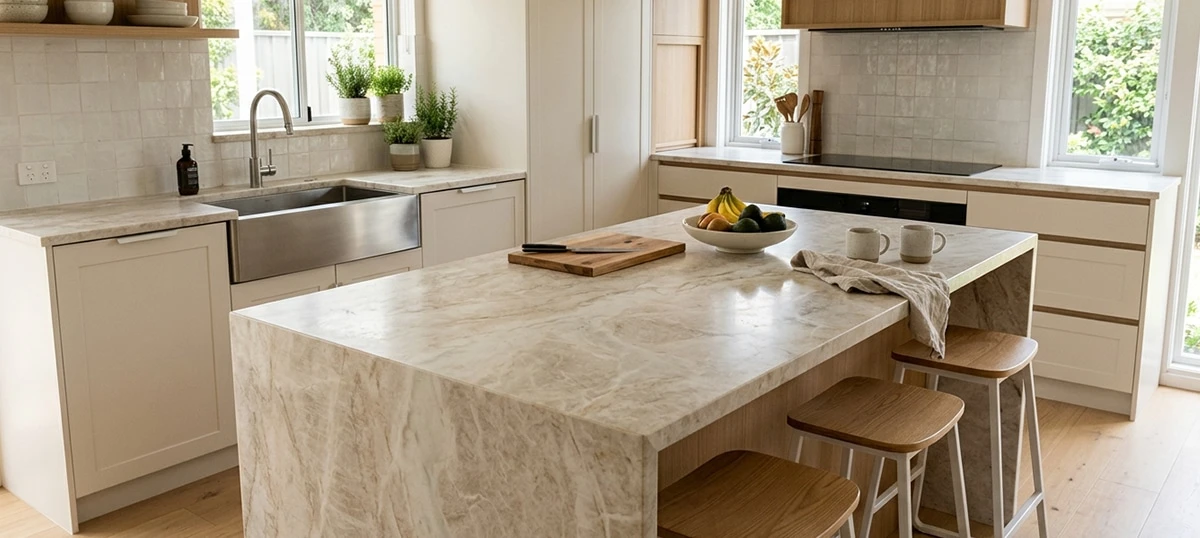
A room becomes interesting when its materials have something to say to one another. Stone brings movement. Timber adds warmth. Metal catches the light. The most comfortable spaces give each of them room to breathe.
Start with one material you love.
Choose the surface that will set the mood. It might be a pale marble with a quiet vein, or a darker stone with a more expressive pattern. Let that choice guide the colours around it, rather than asking every finish to compete for attention.
Find a shared undertone.
Look beyond the first impression of white, grey or black. A warm thread in a slab can sit beautifully beside oak. A cooler background can connect with brushed metal or a softly painted cabinet. Take your samples into the room and look at them together in daylight.
Give texture a role.
A smooth stone surface and an open timber grain offer different kinds of detail. The same is true of a polished edge beside a matte finish. These small contrasts can make a restrained palette feel rich without adding more colour.
Leave a little quiet space.
If your stone has dramatic movement, keep some surrounding surfaces simple. Plain cabinetry, a gentle wall colour and a considered lighting scheme allow the natural pattern to become the focus.
There is no single perfect combination. Put two materials side by side, step back, and notice which one you keep returning to.